
Responsible Gambling: High RTP Isn't a Guarantee

I run an RTP database. Players come here looking for the slots that pay back the most over the long run, and that's a reasonable thing to optimize for. But "highest RTP" is not the same as "guaranteed win" or even "guaranteed positive session." Mega Joker has a 99% RTP. That still means a 1% house edge, which still means the house wins on average. If you walk away from a 99% slot up money, you got lucky. If you walk away down, the math worked exactly as designed. This page is about keeping that math in perspective.
Why RTP Content Can Mislead People if It Is Not Framed Properly
High-RTP content attracts exactly the type of reader who is tempted to think they can turn game selection into a reliable edge. That instinct is understandable. If one slot returns 96.5% and another returns 94.1%, of course the first one is better. The problem starts when “better” turns into “safe” in the player's head. It is not safe. It is simply less bad over a long enough sample, and almost nobody plays a long enough sample for RTP alone to define the session outcome.
That is why I treat this page as part of the core database, not as a legal footer obligation. If I publish RTP numbers without also explaining their limits, I am helping readers form the wrong mental model. A strong responsible-gambling page on an RTP site has one job: stop readers from confusing math literacy with control.
What RTP Actually Means for Your Bankroll
A 96% RTP slot returns 96 cents on every dollar wagered — on average, over millions of spins. In any given session of 100 spins, you might see 90% returns, or 110%, or 50%. Variance is enormous in the short run. Over 10,000 spins it converges closer to 96. Over 100,000 spins it converges closer still. You will probably never play 100,000 spins of a single slot in your life. Which means your personal experience of any slot is dominated by variance, not by RTP.
That's not a reason to ignore RTP. It's a reason to set a budget that you'd be okay losing entirely — because in any given session, the variance can put you anywhere on the distribution curve. The 96% number is what protects you over thousands of sessions, not what you experience in one Sunday afternoon.
The Three Mistakes RTP-Focused Players Make Most Often
- They overtrust a short winning streak. A good run on a 97% game does not mean the game is “hot”.
- They chase “recovery” on low-volatility games. Lower volatility can feel safer, which tempts players to keep spinning longer than they should.
- They believe a better game justifies a bigger bankroll. It does not. Better RTP reduces expected loss rate; it does not remove risk.
If you recognize yourself in any of those, the answer is not more RTP research. The answer is a tighter stop rule and a smaller session budget.
Set a Loss Limit Before You Play
Pin Up provides server-side loss limits in the Responsible Gambling menu. Set the limit at an amount you'd be comfortable losing entirely. If the variance hits that number, the app stops new bets until your window resets. The limit is enforced server-side — you can't bypass it by reinstalling.
- Open the Pin Up app or mobile site
- Profile → Responsible Gambling → Loss Limits
- Choose Daily, Weekly, or Monthly
- Enter your entertainment-budget amount
- Confirm
Increases take a 24-hour cooling-off; decreases are instant. Use it.
A Simple Session Framework for RTP-Conscious Players
If you still want to use RTP intelligently without turning it into an excuse to overplay, this is the cleanest framework I know:
- Pick the game before the session starts. Don't browse endlessly for a “better” RTP once losses begin.
- Set a fixed loss amount, not a spin count. Spins are too easy to manipulate mentally.
- Set a fixed time window. Even high-RTP games can grind away a bankroll over long sessions.
- Do not switch to jackpots or bonus buys out of frustration. That usually means the session has already gone off-plan.
- When the stop point hits, stop. The RTP edge you selected has already done all it can do.
That last line is the important one. Once your stop-loss is hit, no further amount of math optimization improves the decision. The optimal move becomes leaving.
Other Tools Pin Up Provides
Deposit Limits
Same menu, different option. Caps how much you can fund the account. I personally recommend setting both a deposit limit and a loss limit — the deposit limit prevents you from chasing losses by reloading.
Session Time Limits
Caps your continuous session length. Useful for breaking the "just one more spin" loop. Set it to 60 minutes or less.
Self-Exclusion
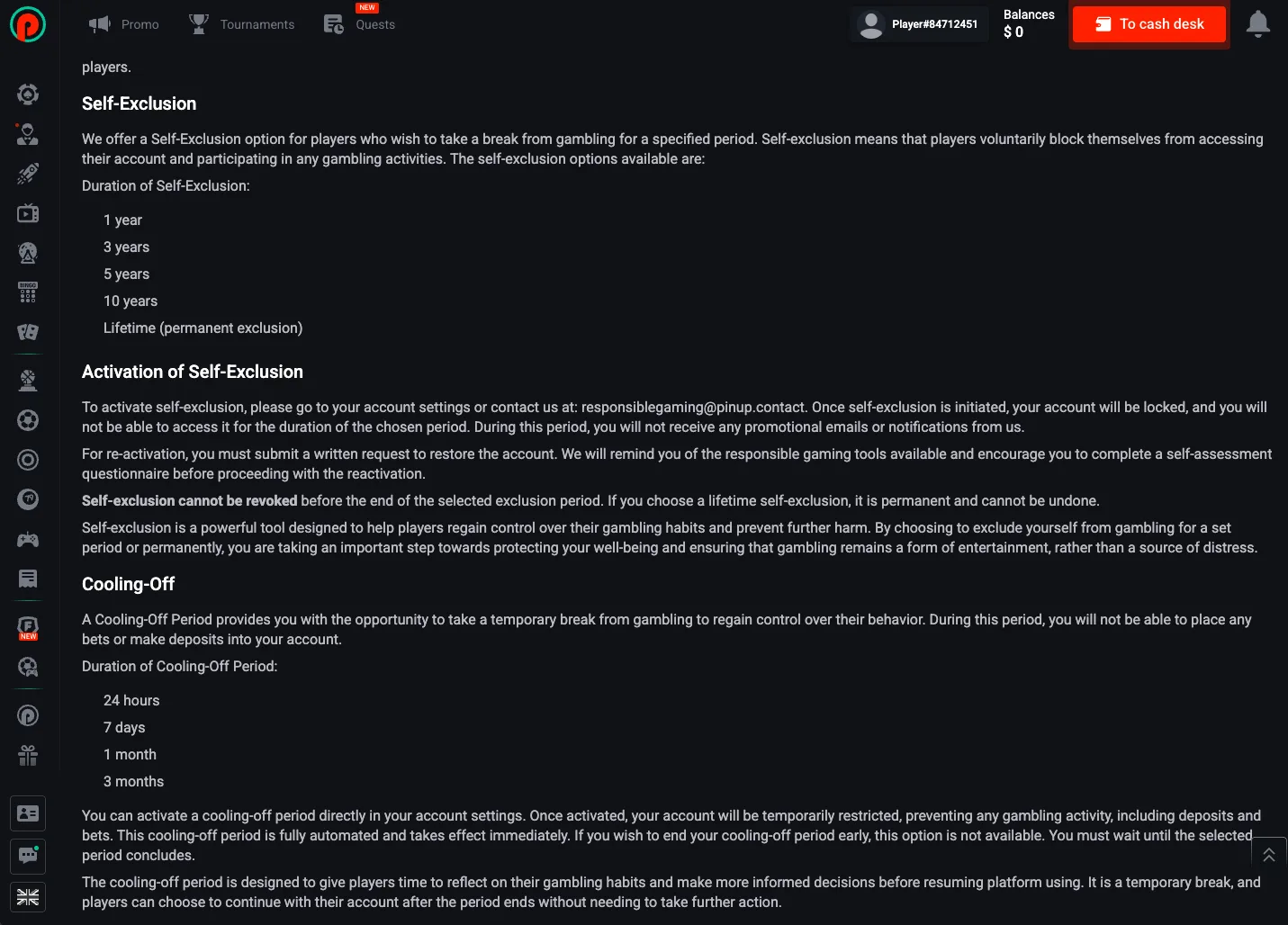
Cool-off periods of 24 hours, 7 days, 1 month, 6 months, or permanent self-exclusion. Once active, support cannot reverse the period until it ends. Permanent self-exclusion is final.
Warning Signs
- Spending more time or money on slots than you planned
- Chasing losses with bigger bets
- Borrowing money to play
- Lying to family or friends about gambling
- Feeling anxious or irritable when not playing
- Trying to stop and being unable to
If any of these resonate, talk to one of the helplines below. They're free and confidential.
RTP-Specific Warning Signs
- You keep telling yourself that a 97% game “should” recover if you play longer.
- You raise stake size because the RTP number feels scientifically reassuring.
- You justify a losing session by saying the game is still “good in the long run”.
- You switch from a normal slot to a higher-RTP title after losses and call it bankroll management.
Those are not signs of disciplined play. They are signs that a useful metric has become a rationalization tool.
International Helplines
- BeGambleAware — 24/7, English. begambleaware.org | 0808 8020 133
- GamCare — UK National Gambling Helpline. gamcare.org.uk
- Gambling Therapy — multiple languages. gamblingtherapy.org
- Gamblers Anonymous — peer meetings. gamblersanonymous.org
Regional Helplines
India
- iCall — +91 9152987821 | icallhelpline.org
Brazil
- Jogadores Anônimos Brasil — jogadoresanonimos.com.br
Why I Wrote This Page Personally
RTP databases attract players who think they can beat the house. I built this database because I think RTP is real and worth tracking — better games are better than worse games, and the data should be public. But I don't want anyone landing here believing that picking a 99% slot makes them a guaranteed winner. The math doesn't work that way. The house edge is real, the variance is enormous, and the only way to enjoy slots long-term is to treat them as entertainment with a fixed budget. Set the limits. Use the tools. Walk away when you've had your fun. That's the playbook.
If a reader leaves this site knowing the difference between “better game selection” and “control over outcomes,” then this page has done its job.